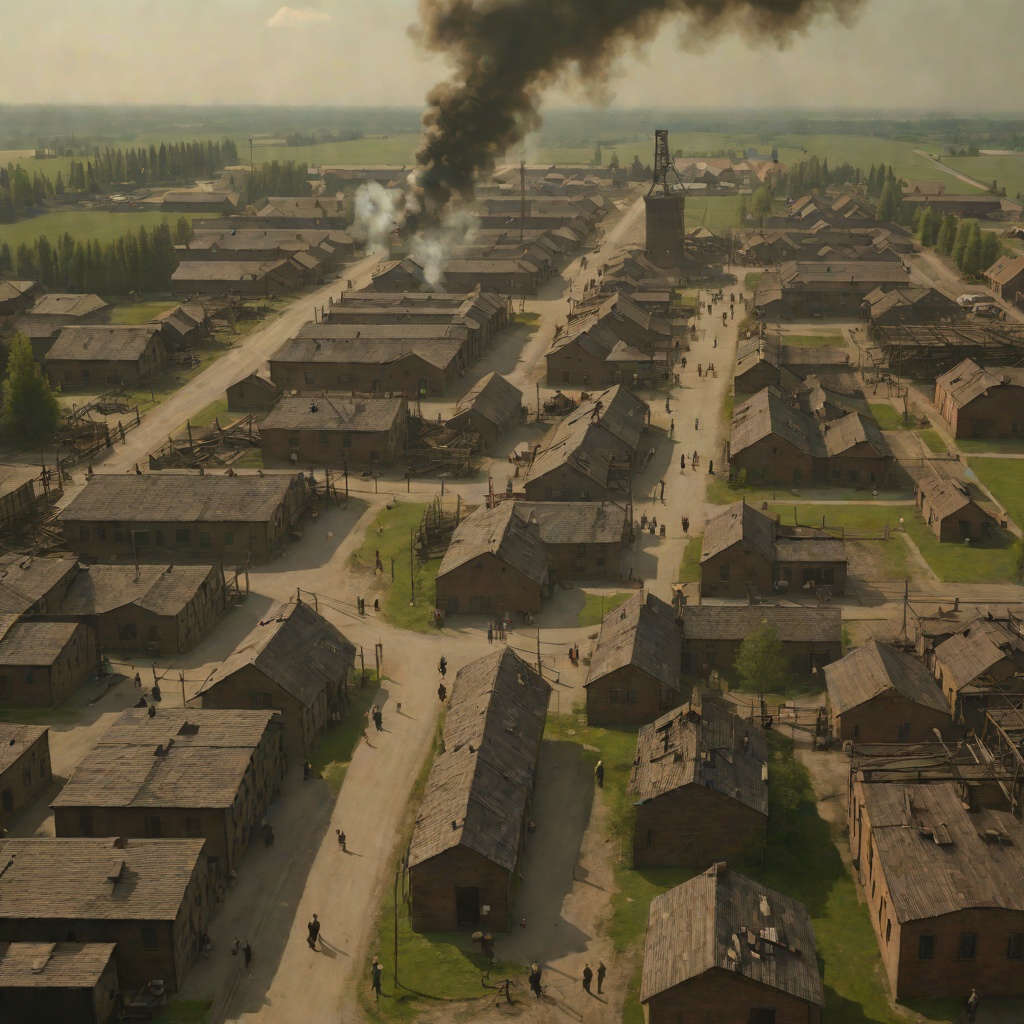
Crematorium One
The Tattooist of AuschwitzCrematorium One is the first purpose-built extermination facility at Auschwitz, the structure that converts the camp's abstract menace into a concrete, industrial machinery of murder. Its existence is revealed to Lale Sokolov not through official announcement but through a quiet, devastating confidence from his friend Victor, who has seen the building's plans. The revelation lands as a seismic shock, reordering everything Lale thought he understood about the place where he is imprisoned and forcing him to confront the true terminus of the camp's brutal logic. It is the building that gives the Arbeit Macht Frei gate its sick irony and the tattoos Lale himself is forced to apply their ultimate, horrifying purpose.
The Revelation of Purpose
The knowledge of Crematorium One arrives indirectly, during a conversation between Lale and Victor. Victor, having seen the plans, delivers the information with a reluctance that signals its gravity: "This building. I've seen the plans. You're not going to like what it is." Lale, standing and bracing himself on a pile of bricks, responds with a defiance born of his daily exposure to horror, insisting that nothing could be worse than what is already happening in the camp. Victor's quiet reply — "It's called Crematorium One" — and his averted gaze carry the weight of the revelation. Lale's stunned repetition, "Crematorium. One. With the possibility of a number two?" captures his mind struggling to process the scale of the operation, the implication that this is not an isolated atrocity but the first of a planned series. Victor's apology, "Sorry. I said you wouldn't like it," confirms that the knowledge is a burden, one that Lale receives with a visceral, physical response: he punches the last brick laid, sending it flying, and shakes his hand in pain, the gesture a futile, instinctive rebellion against the immovable fact of the building's purpose.
The Architecture of Arrival and Deception
Crematorium One sits within the landscape of deception that defines the camp's entrance. When Lale first arrives at Auschwitz, he is marched through open iron gates toward looming, dirty pink-brick buildings with picture windows, trees lining the entrances flush with new spring growth. Above him, the German words ARBEIT MACHT FREI are wrought from the metal, promising that work will set him free. The contrast between the pastoral setting and the building's true function is the camp's central lie, and Crematorium One is the most extreme expression of that deception. The building's innocuous exterior — the picture windows, the spring trees — masks an interior designed for mass murder, just as the gate's promise masks the camp's true purpose. Lale, who does not know where he is or what work he will be expected to do, already senses that the idea of being set free has the feeling of a sick joke; the revelation of Crematorium One confirms that the joke is far darker than he could have imagined.
The Gas Van and the Machinery of Murder
The horror that Crematorium One represents is prefigured and made visceral by an earlier scene Lale witnesses at Birkenau, where the camp's murderous machinery is tested in a more improvised form. On a beautiful spring day, Lale watches a large, enclosed truck drive around the back of the administration building, past the usual point for unloading building supplies, toward an area near the boundary fence he has never dared to venture. Curiosity gets the better of him, and he follows with an air of belonging. He peers around the corner to see the truck pull up beside an odd bus adapted into a bunker, with steel plates nailed across the window frames. Dozens of naked men are herded out of the truck and led toward the bus; some enter willingly, while those who resist are hit with a rifle butt and dragged by fellow prisoners to their fate. The bus is so full that the last men to board cling to the steps with their tiptoes, their naked bottoms hanging out the door, as officers shove their weight against the bodies. The doors are slammed shut, an officer walks around rapping on the metal sheets to check that everything is secure, and a nimble officer clambers onto the roof with a canister in his hand. Lale, unable to move, watches as he opens a small hatch and upends the canister, then slams the lid down and latches it. As the guard scurries down, the bus shakes violently and muffled screams can be heard. Lale drops to his knees, retching, and remains there, sick in the dirt, as the screams fade. This gas van is the crude precursor to the industrial efficiency of Crematorium One, the same murderous intent rendered in a more portable, improvised form.
The Tätowierer's Proximity to Death
Crematorium One's construction and operation form the dark backdrop to Lale's own role in the camp's machinery. As the Tätowierer, Lale is given a single room in a new block near the camp's entrance, a small, isolated space that separates him from his friends in Block 7. He takes his meals in an area near the administration building and receives extra rations, with the explanation that "We want our workers to have their strength." This privileged position places Lale in close physical proximity to the camp's administrative heart, the same zone where the gas van operates behind the administration building and where Crematorium One is being built. The irony is stark: Lale's job is to mark prisoners with numbers, to process them into the camp's system, while the building Victor describes is designed to process them out of existence. The tattoo and the crematorium are two ends of the same assembly line, and Lale's special treatment — the extra rations, the private room — is the price of his complicity in a system whose ultimate product is ash. The revelation of Crematorium One forces Lale to see his own role in this machinery with new, horrifying clarity.
The Weight of Knowing
Lale's reaction to the revelation of Crematorium One — the punch that sends a brick flying, the shaking hand — is the physical expression of a psychological rupture. The knowledge of the building's purpose transforms his understanding of the camp from a place of arbitrary cruelty to a site of systematic, industrialized extermination. It is the moment when the abstract horror of the Arbeit Macht Frei gate becomes concrete, when the sick joke of being set free through work is revealed as a genocidal lie. The building's existence also casts a shadow forward over Lale's entire time in the camp, informing his desperate efforts to survive, to protect Gita, and to hold onto the hope that he will walk out a free man. Crematorium One is the destination that gives the camp's machinery its ultimate meaning, the terminus that Lale must evade through every act of smuggling, every letter, every moment of love and resistance. It is the building that makes his promise to Gita — that there will be a tomorrow for them — an act of defiance against the very architecture of death.